
" Through the transformation of everyday objects, I amplify poetic connotations to evoke allegories of intimacy and embodiment. Using mixed media assemblage, I interrogate how desire bridges beauty and abjection, and how the semiotics of materials convey cultural meanings."
" Through the transformation of everyday objects, I amplify poetic connotations to evoke allegories of intimacy and embodiment. Using mixed media assemblage, I interrogate how desire bridges beauty and abjection, and how the semiotics of materials convey cultural meanings."
" My work centers on working-class, midwestern American people. For the past several years, I have found it helpful to work from a fictional place — an imaginary town I named Holmes, Missouri, drawn equally from upstate New York, where I live, and Missouri, where I grew up. The striking similarities between these disparate rural landscapes allow Holmes to speak more broadly about small-town American life. "
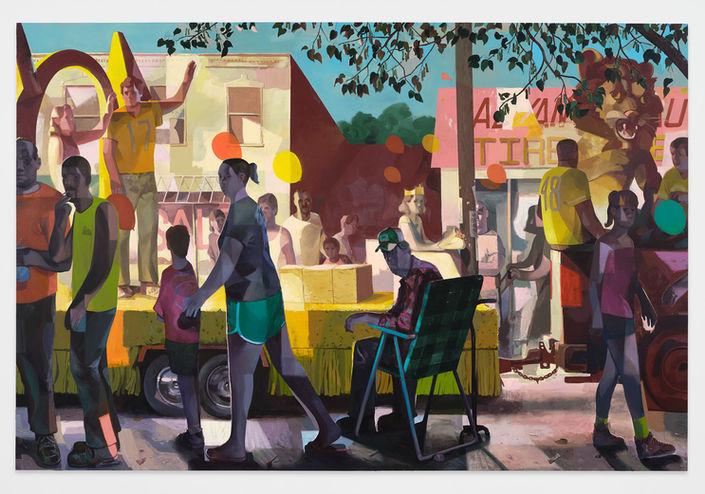
Homecoming, 2025
Could you speak about your background and upbringing, and how those early experiences continue to shape the people, places, and situations that appear in your paintings?
I grew up outside of Kansas City, Missouri. My mother's side of the family were farmers in northeast Kansas, and my father's mother lived in central Missouri on the Lake of the Ozarks. My experiences visiting family in these rural locations shaped the images and stories I tell through my work.

Homecoming, 2025
Your paintings often focus on ordinary moments, such as someone stepping out of a car, workers pausing mid-task, or people gathered in public space. What draws you to these in-between moments rather than more obviously dramatic scenes?
Growing up, I read a lot of Marvel comics—drawings full of action. But in my own work, that kind of movement or drama started to feel overly staged. I prefer suggestive moments that imply a lot and leave room for the audience to step in and complete the work. I'd like the paintings to have a lot of sustain, to borrow a musical term, rather than presenting a fully encapsulated event with a clear beginning and end.
Many of your figures look directly outward, as if they are aware of being seen or are looking beyond the space of the painting. What does this outward gaze mean to you?
When I look at paintings, I'm acutely aware of the point of entry into the imaginary environment and the visual relationships between its different elements. In my own work, I'm drawn to images that acknowledge the audience—there's something I have to step over or through before entering the painting. In college, I saw Kerry James Marshall's work for the first time, in an exhibition of his large early canvases in Kansas City. One painting, Campfire Girls, has the words "Here I Am" painted in the night sky over two children having a backyard campout. They stare directly at you, giving the impression that they're really seeing you—and demanding the same in return. That's stuck with me ever since.

Betterhalf, 2024
There is a strong sense of narrative in the work, but the stories remain a mystery. We seem to enter the image in the middle of something. How do you think about storytelling in your paintings?
Roland Barthes had a great term for the sense of life existing outside a photograph: the blind field. It's the fact that a photo is a document of one moment within a much larger life that lets me imagine that blind field—what did this person eat for breakfast, who did that child grow up to be? I like to treat paintings as though they have a blind field too: what happens beyond the frame? That suggestiveness lets the painting continue to live in the viewer's mind beyond what's immediately visible. My sense of narrative is tied to this idea, which is why I tend to think in images or moments rather than in larger plotlines. I'm in the audience too, seeing my own work and imagining right along with everyone else.

Homecoming, Installation View, 2025, François Ghebaly Gallery. Photo: Paul Salveson, Los Angeles.

Uncle Dave, 2023
Your paintings often focus on ordinary moments, such as someone stepping out of a car, workers pausing mid-task, or people gathered in public space. What draws you to these in-between moments rather than more obviously dramatic scenes?
Growing up, I read a lot of Marvel comics—drawings full of action. But in my own work, that kind of movement or drama started to feel overly staged. I prefer suggestive moments that imply a lot and leave room for the audience to step in and complete the work. I'd like the paintings to have a lot of sustain, to borrow a musical term, rather than presenting a fully encapsulated event with a clear beginning and end.
Cars, trucks, roads, tools, uniforms, and public streets appear throughout the work. What role do these everyday objects and settings play in building the emotional world of the paintings?
I think a lot about how objects anchor us in a particular moment. I want my work to exist in a present-day context, and the specificity of these objects helps do that. At times they're also regionally specific—clearly American, and often Midwestern. They're the kinds of things working-class people would own or wear. These details ground the narrative world and give the audience something concrete to sift through.

Shared Custody (Slot Car Racer), 2025
The figures in your paintings feel specific and closely observed, yet they also carry a sense of familiarity beyond the individual. How do you approach creating the people who inhabit these scenes?
My characters are constructed and composited from people I've known, from lived experience, and from a fictionalizing process. I don't work from photographs; instead, I build my characters through drawing, getting to know them as I go. Painting teaches me more about who they are. Like a novelist, I want each character to feel alive, with their own impulses and their own choices to make. Sometimes I know a great deal about them—I've been drawing up family trees recently—but other times they emerge through the painting process itself, and I have to spend time afterward getting to know them.
There is a recurring tension in the work between tenderness and unease, with moments of care, labor, fatigue, attention, and silence. Is that emotional tension something you consciously seek in the paintings?
I try not to judge the characters I create. Instead, I try to make room for their complexity to emerge and for the experience of the painting to remain ambiguous. Often this means several, possibly conflicting feelings sit in tension with one another, and I don't try to resolve that for the viewer. Art seems to me like a place where unresolved complexity and tension can simply live.

Parade's End, Installation View, 2026, Mother's Tankstation. Dublin

Do you have any upcoming projects, exhibitions, or new directions in your practice that you would like to share?
Last month I closed a solo exhibition, Parade's End, at mother's tankstation in Dublin. Next week I'll have new work in an exhibition at the Nemeth Art Center in Minnesota, curated by Aaron Spangler. Right now I'm finishing a new hand-painted stop-motion animation called Waiting Room, about a father-and-son auto repair business in Holmes. I look forward to sharing it soon.
All images courtesy of the artist
Interview publish date: 07/20/2026
Interview by the Meridian Award