
" Through the transformation of everyday objects, I amplify poetic connotations to evoke allegories of intimacy and embodiment. Using mixed media assemblage, I interrogate how desire bridges beauty and abjection, and how the semiotics of materials convey cultural meanings."
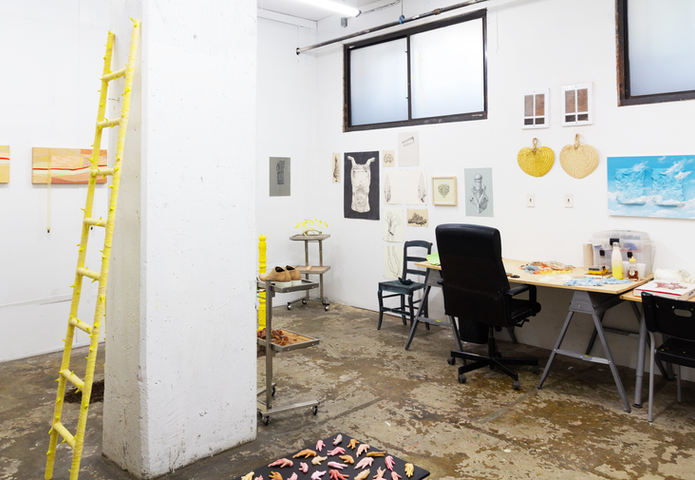
Artist's Studio , 2026

Could you speak about your background and how your personal history has shaped the materials, objects, and bodily forms that appear in your work?
I grew up in a family predominantly comprised of medical practitioners. My maternal grandfather was an orthopedic surgeon, my paternal grandfather was a pharmacist, several of my aunts are nurses and physicians, my sister is in medical school currently, and so on and so forth. The
history of medical practice runs deep in my family, as many Filipinos can relate to. Growing up around that kind of language is what I believe led me to probe questions of the body as an artist. I grew up perceiving the body as something tactile and remarkable, something in need of
maintenance, something that is a product of the care and labor of others. Now that I often use corporeal fragments in my pieces, I can easily trace that obsession back to my upbringing.
I was also raised in a rural suburb in the Hudson Valley, so my childhood was largely spent in nature. Moving to New York City for my undergraduate and graduate degrees exposed me to an entirely opposite ecosystem, and I believe both influence my work today. I often bring natural
mediums (sand, soil, wood) in conversation with synthetic or industrial materials (vinyl, metal, resin). That friction between textures is what informed my general worldview as a young creator, so it makes sense that it continues to animate my compositions today.
Be With Me (Not Here, Not There Either) , 2026

Take Me With You, Again and Again, 2026
Your sculptures often transform familiar objects, such as fences, beds, tiles, and other domestic materials, into something strange and emotionally charged. What draws you to these everyday forms?
m obsessed with things. I’m fascinated by the way we become attached to objects of comfort, fiercely and almost without noticing. Everyday objects sit so close to our lives that they become charged, almost talismanic. They’re unwilling material witnesses. Hito Steyerl writes that “things are never just inert objects, passive items, or lifeless shucks, but consist of tensions, forces, hidden powers, all being constantly exchanged.” My work is a method of mining that exchange, of foregrounding how things remember and protect intimate histories.
I’m especially drawn to family heirlooms. Something passed down between generations carries its own temporal weight, as if it has survived decades of volatile conditions and displacement alongside the people who safeguarded it. In this light, objects can also transmit latent stories of migration. For diasporic communities in particular, objects operate as tethers of connection to
spaces that are still lived in memory but no longer inhabited. They evolve to embody what’s been lost.
And I’m curious about what occurs when objects “fail.” What happens when their use-value is destroyed or queered through transformation? Using domestic objects against the grain of their intended use lets me imagine new ways of being for them, futures that are stranger and maybe more liberated in a weird sense.
Several of your works place objects, body fragments, or forms in pairs. What draws you to this sense of doubling, mirroring, or two forms existing together?
Doubling is a formal device I first adopted from Felix Gonzalez-Torres, who frequently deployed the paired image as a metaphor for same-sex desire, even as it deemphasized figuration. Read against the context of the ongoing AIDS epidemic he was living through, this motif takes on a mournful quality as it becomes a prolonged confronting of loss. A pair can be read as an implied rehearsal for what happens when one half is gone. Duality denotes separation as much as it does codependence, exacerbating and bridging fault lines in equal measure.
My own use of pairs is often more representational and less industrial in material, but the intent is similar. I turn to identical forms to imply homoeroticism, and intentionally keep them in an enduring state of togetherness—even if that state is occasionally claustrophobic or awkward.
Sometimes I shift how they’re positioned: close enough to touch, or separated by something like a fence. That distance does a lot of work. It registers how difficult it is to sustain a community of two, and how intimacy can both bond and estrange.

Meet Me in the Middle , 2026

To Whom I Belong, 2026
Many of your works suggest the presence of a body without revealing it completely. What draws you to
showing the body through fragments, traces, or partial forms?
There’s something wonderfully queer and flirtatious about the sneak peak, or the partial reveal. In her book, “On Longing,” Susan Stewart writes, “the cover, of course, makes nature all the more titillating. The cover invites exposure; it always bears the potential of striptease.” Fragmenting or hiding the body in my work follows that logic: it’s a promise of more to come, a way of prolonging eroticism for both the performing object and the viewer themselves.
There’s also something subversive about partial revelation now, especially in today’s media landscape built on full and instant exposure. Keeping some things private and hidden allows me to gift back some level of agency to the characters in my sculptures. I like to think they choose how much of themselves to show, and in doing so refuse the infamous “gaze” that dominates so much of art historical discourse.
And because every body part in my work is cast directly from my own form (which brings with it the positionality of a queer Filipino-American body), questions of consumption inevitably arise. Whose bodies are traditionally centered and desired? How do we ascribe identity to basic visual cues like color, size, and form?

Are You Strill Strong Enough, 2026
There is a recurring tension in your work between beauty and discomfort. The objects can feel intimate,
unsettling, and bodily at the same time. How do you approach that balance?
I always try to create pieces that do many things with as little gestures as possible, or pieces that marry forces we typically think of as oppositional. Pain and pleasure, fear and fetish, beauty and abjection, seduction and repulsion, private and public, internal and external, uncanny and familiar. In my studio, these dichotomies feel much more akin than different. So in balancing those tensions, I’m really just attempting to convey the simultaneity of experience, or the way a single moment can hold a plurality of sentiments.
Practically, that means I’m often looking for the material or gesture that can carry two contradictory readings at the same time, rather than choosing one. A surface that's soft enough to invite touch but textured in a way that makes you hesitate. A form that reads as tender from one
angle and visceral from another. What I want is for the viewer to feel both pulls at once, like how intimacy itself often feels: a little unsettling, a little overwhelming, a little too close, a little too anticipated.

You Taste Like Forever , 2026

I Want to Know, I Need to Know, installation view, 2026. Eli Klein Gallery, New York.
Your use of materials often creates a contrast between softness and hardness, or between the organic and the constructed. How do you choose materials, and what role does material transformation play in the
work?
Material and texture are the first and last thing I think about when making a work. I always prioritize what Kiyan Williams calls “haptic intimacy,” or treating surfaces with such care and intention that it invites the desire to touch. When it comes to material selection, I place a great deal of emphasis on site specificity, focusing on where I source my materials and how that origin animates the afterlife of the work. Soil from Queens, NY where my grandparents first immigrated. Confetti from my favorite queer nightclub. Sand from historical cruising sites. Palm
leaves from traditional Filipino brooms. Ropes washed onto the shores of Provincetown. The list goes on. I’m intentionally cross-pollinating materials with latent histories and cultural charges, in hopes of locating something novel in their combination.
How I transform those materials is dependent on the project, and what the objective is. Sometimes I want the material to take center stage and speak for itself, so I leave it mostly alone. Other times, the alchemy of the studio takes over, and it becomes just one ingredient in a longer recipe of modification. It’s all very intuitive.
You have written about resisting the expectation that identity must be fully transparent, especially for
queer artists of color. How do concealment, abstraction, and privacy become forms of agency in your work?
I’ve certainly felt that obligation to make my identity explicitly legible in my work as a queer artist of color, but it’s by no means unique to my position. Any artist with a marginalized identity can relate to this pressure to make visible one’s “difference” or “struggle,” especially as that kind of work is often granted a lot of cultural capital. That’s not a value judgment; some of the most powerful work ever made has centered identity as their conceptual engine. I’m really interested in Gayatri Spivak’s concept of “strategic essentialism,” which approaches this dilemma with a politically galvanizing motivation. But personally, I think it’s more fun (albeit more challenging) to evade this expectation, and find more coded ways of expressing personal experience that sidestep traditional procedures of categorization. I like how Tom Burr put it during a conversation with David Getsy at SculptureCenter in 2025; he said he likes to make work from rather than about his identity. That’s how I make things. Every piece is distilled from my own experience, yet that process doesn’t always manifest in a transparent manner. I’m very much of the “if you know, you know” school
of thought.
Concealment isn’t the opposite of disclosure, it’s just a different register of it. When I abstract or hide part of an identity marker, I'm not erasing it; I'm asking the viewer to work for it, the way I've had to work to understand my own layered histories. That withholding gives me control over
the terms of my own visibility (who gets access, and how much). It also refuses a kind of extractive looking that marginalized artists are often subject to, where identity is expected to perform itself legibly for an audience’s consumption or education. Privacy, in that sense, isn’t a
retreat from politics. It's a politics of its own, one that argues not everything about me is owed to
the room.
All images courtesy of the artist
Interview publish date: 07/20/2026
Interview by the Meridian Award